East Hampton's Busiest Cultural Month Isn't August. It's October.
read article
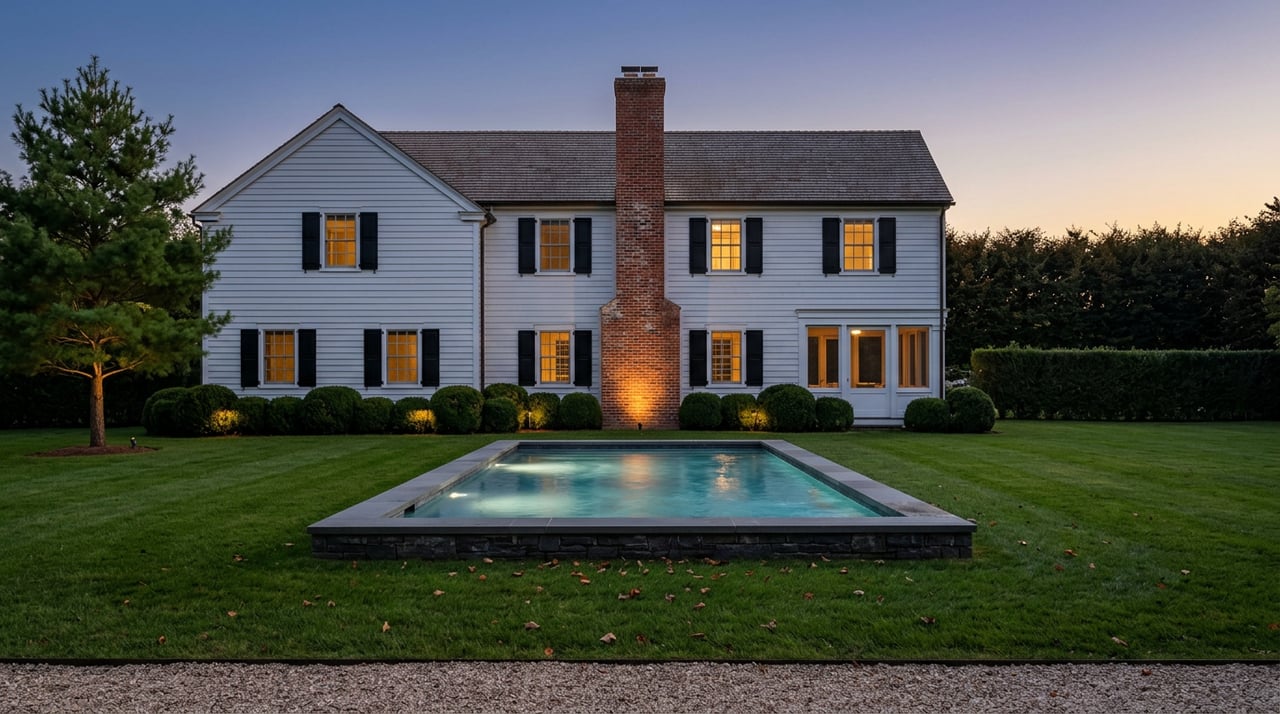
A buyer comparing Wainscott to East Hampton or Bridgehampton on price alone is comparing the wrong number. The median tells you what a typical Wainscott home costs. It says nothing about which side of a single 4,255-foot runway that home sits on, and it says even less about how long the legal fight over that runway is going to last.
That fight is not settled history. It is live, and as of this year it is still unresolved in a way that matters to anyone signing a contract on a Wainscott property in the next twelve months.
East Hampton Town Airport, still known by its old code HTO to most residents and now carrying the FAA designation JPX, sits inside Wainscott itself, on Wainscott Road about two miles west of East Hampton Village. It opened in 1937, predating LaGuardia and JFK, and today handles more than 30,000 flights a year at peak summer volume. A helicopter from Manhattan reaches it in roughly 40 minutes. The same trip by car on a July Friday can take three to four hours.
That gap between air time and drive time is the entire reason the airport exists as a real estate factor at all, and it is also the entire reason the fight over it has run for more than a decade without resolution.
Here is where the paperwork gets strange. In May 2022 the town tried to close the airport for 33 hours and reopen it days later as a private facility with curfews and trip limits. A state Supreme Court justice blocked that plan with a temporary restraining order one day before the closure was scheduled to take effect. The town went ahead with parts of the change anyway, and for nearly three years the airport was mislabeled as private-use on FAA charts and databases, a status the National Business Aviation Association confirmed was finally corrected back to public-use in February 2025. Around the same period, an appellate court ruled that the town could not simply close and reopen the field as private without first completing the federal review process required under the Airport Noise and Capacity Act, a process that involves extensive analysis, public comment, and FAA approval on a timeline measured in years, not months.
The result is an airport that is legally public, practically unrestricted beyond voluntary noise guidelines, and still the subject of active advocacy heading into 2026.
The economics here split cleanly along a line that has nothing to do with square footage. The person paying $250,000 for a seasonal helicopter share treats the flight as a business expense and the airport as a door that saves four hours every trip. The person who bought a house under the flight path treats the same aircraft as a recurring intrusion that a high sale price can't undo. One group captures nearly all the benefit. The other absorbs nearly all the cost. That mismatch, not the noise level itself, is what has kept the litigation running since 2015.
It also explains why the town board has struggled to act. The residents who vote in Wainscott live there year-round. The traffic that funds a meaningful share of the local tax base arrives for roughly twelve weeks each summer, often by air. A town board answering to one group has limited leverage over the economic activity driven by the other.
The Wainscott Citizens Advisory Committee, the closest thing residents have to an organized voice on this, has been blunt about how little progress that structure has produced. At a meeting in early 2026, the committee noted that years of litigation and more than $9 million in legal fees had brought no relief in the form of actual restrictions on aircraft operations. The committee's own plan, prepared and endorsed that meeting, calls for a three-tier strategy: build coalitions with other communities affected by the same traffic, including Montauk and parts of the North Fork and New York City, track proposed state legislation on helicopter noise taxes, and keep the option of eventual privatization on the table for the long term. None of that is a restriction in place today. It's a roadmap for one that may or may not exist years from now.
The Quiet Skies Coalition, a local group that has pushed for aircraft limits, has estimated that the restrictions the town originally tried to impose in 2022 could cut helicopter-related complaints by 92 percent and overall noise complaints by 70 percent. That estimate has never been tested in practice, because the restrictions themselves have never taken effect. The appellate ruling means any future version has to survive the ANCA review process first.
For a buyer, the honest way to read that number isn't as a promise of quieter summers ahead. It's a measure of how much is currently unresolved. A 92 percent reduction in complaints is meaningful only if you believe the restriction producing it will actually be implemented, and nothing in the current legal record supports a firm timeline for that.
| Period | What happened |
|---|---|
| 2015 | Town adopts curfew and trip-frequency restrictions; litigation begins almost immediately |
| September 2021 | Federal grant assurances expire, opening the door to the town's private-use plan |
| May 2022 | Town attempts to close and reopen the airport as private-use; a TRO blocks full implementation |
| 2022 to early 2025 | Airport mislabeled as private-use on FAA charts during the dispute |
| 2024 | Appellate court rules the town must complete the federal ANCA process before imposing new restrictions |
| February 2025 | FAA corrects the airport's designation back to public-use |
| 2026 | Wainscott Citizens Advisory Committee reports more than $9 million spent in legal fees with no restrictions in effect; committee adopts a multi-year coalition and legislative strategy |
Nothing in that sequence points to a near-term change in how the airport operates. It points to a dispute that has outlasted several town boards and shows no sign of resolving on a predictable schedule.
A comp sheet will tell you what similar Wainscott homes sold for. It won't tell you whether the house you're considering sits under one of the departure or arrival corridors that see repeated traffic through July and August, or whether it's positioned in a quieter pocket of the hamlet. That distinction can matter more to your day-to-day experience of ownership than another quarter-acre of lot size.
Before writing an offer on a Wainscott property, it's worth working through a short list with your agent:
None of this is a reason to avoid Wainscott. It's a reason to do the specific homework the situation actually requires, rather than relying on a median that averages a dozen different flight-path experiences into one tidy number.
Some buyers reason that the smart move is to wait until the litigation resolves one way or the other before committing. That reasoning assumes resolution is coming on a timeline that matches a normal home search. Nothing in the record supports that. The ANCA process alone is measured in years, and the appellate ruling only restarted the clock on it. A buyer who waits for legal certainty in Wainscott may simply be waiting through several more summers of the same status quo, while the properties least affected by flight paths continue to trade at a premium that reflects exactly the scarcity this dispute has created.
Has the airport actually been restricted at any point? Not in a way that has held. The 2015 curfew and the 2022 restrictions were both challenged in court, and the 2022 plan was blocked before it took effect. As of 2026, the airport operates under voluntary noise abatement only.
Is the airport at risk of closing? The town has said that if it cannot convert the field to private-use, closure remains an option it has considered. The aviation industry has signaled it will contest any closure attempt with the same intensity it has brought to every restriction so far. Treat closure as a stated possibility, not a scheduled outcome.
Does proximity to the airport always lower value? Not uniformly, and this article isn't a substitute for a site-specific noise assessment or legal advice about disclosure obligations. What it does mean is that two Wainscott properties at similar price points can offer meaningfully different ownership experiences, and that difference is worth investigating before you're under contract, not after.
Wainscott rewards buyers who look past the headline number. If you're weighing a property here against the rest of the South Fork and want a clear read on how a specific address sits relative to this dispute, Matthew Breitenbach and the Breitenbach Advisory team can walk the specifics with you. Request Private Access to start that conversation.